| Food & Beverage · Brand Positioning & Identity |
CLIENT
Coffee Central Roasting Co., Nottingham
Industry: Food & Beverage — Ethical Coffee Roasting
Work: Brand Positioning, Name Evolution, Visual Identity
Market: B2B (wholesale, hospitality) and B2C (direct retail)
The Challenge
Coffee Central had been operating in Nottingham for over 20 years. In that time they had built something genuinely valuable: a team of Graders, Roasters, a reputation for after-sales care, and a loyal base of hospitality businesses who trusted them. But that same history had created a perception problem.
Because the business had become known for equipment supply; coffee machines, kit, maintenance, rather than coffee roasting. That was how the market still largely understood them. Coffee Central was seen as n equipment supplier. The fact that they were also roasting exceptional coffee, sourced ethically and crafted with real expertise, was either unknown or underweighted in the minds of the customers they most wanted to reach.
The commercial stakes were clear: equipment supply is a transactional relationship. A coffee roaster with a distinctive identity and a wholesale proposition commands a fundamentally different kind of loyalty.
Gavin Dow, Managing Director, needed the brand to reflect where the business actually was — and where it was going. The engagement wasn’t triggered by a design brief. It was triggered by a positioning question: how do you shift market perception without abandoning the heritage that made the business trustworthy in the first place?
| The core tension Equipment supply had built the business. But it was also limiting how the market saw it. The brand needed to foreground the roasting operation — without making existing customers feel like the business they’d relied on had disappeared. |
The Strategic Thinking
The first task was to understand what Coffee Central’s brand equity actually contained. Twenty years in a market creates something worth examining carefully before you change it. The business had earned trust through consistency, technical expertise, and a genuine commitment to quality — and that quality had a traceable origin. They were sourcing from small, independent growers. They knew where their beans came from. They cared about the people growing them.
That last point turned out to be the strategic key.
The initial framing considered craft, ethics, and community as three separate positioning directions. But the more the engagement developed, the clearer it became that these were not three options — they were three dimensions of a single story. And the sourcing relationship was what held them together.
| The strategic insight Craft without provenance is technique. Ethics without specificity is a claim. Community without a human face is marketing language. Coffee Central’s sourcing relationships — small growers, known origins, genuine passion for the journey from field to cup — gave all three dimensions something real to stand on. |
‘From field to cup’ became the narrative spine of the positioning. Not as a tagline, but as an organising idea. It gave the brand a story that ran the full length of the supply chain: starting with the grower and the conditions in which the coffee was grown, moving through the roasting process where that quality was preserved and expressed, and ending with the cup — whether in a hospitality venue or a consumer’s home.
This mattered for the dual B2B and B2C audience in different ways. For wholesale hospitality buyers, the sourcing story gave them something to pass on to their own customers — origin stories, grower relationships, the craft behind the cup. For direct consumers, it provided exactly the kind of authentic provenance that separates a genuine roaster from a commodity supplier.
Critically, this was a story that Coffee Central could own because it was true. In a category where ‘ethical sourcing’ has become a generic claim made by brands with no meaningful relationship with their supply chain, the specificity of small growers and known origins was a genuine differentiator — not a marketing construct bolted onto an existing product.
The Decisions That Mattered Extending the name
The single most significant strategic decision in this engagement was also the simplest: the addition of ‘Roasting Co.’ to the brand name.
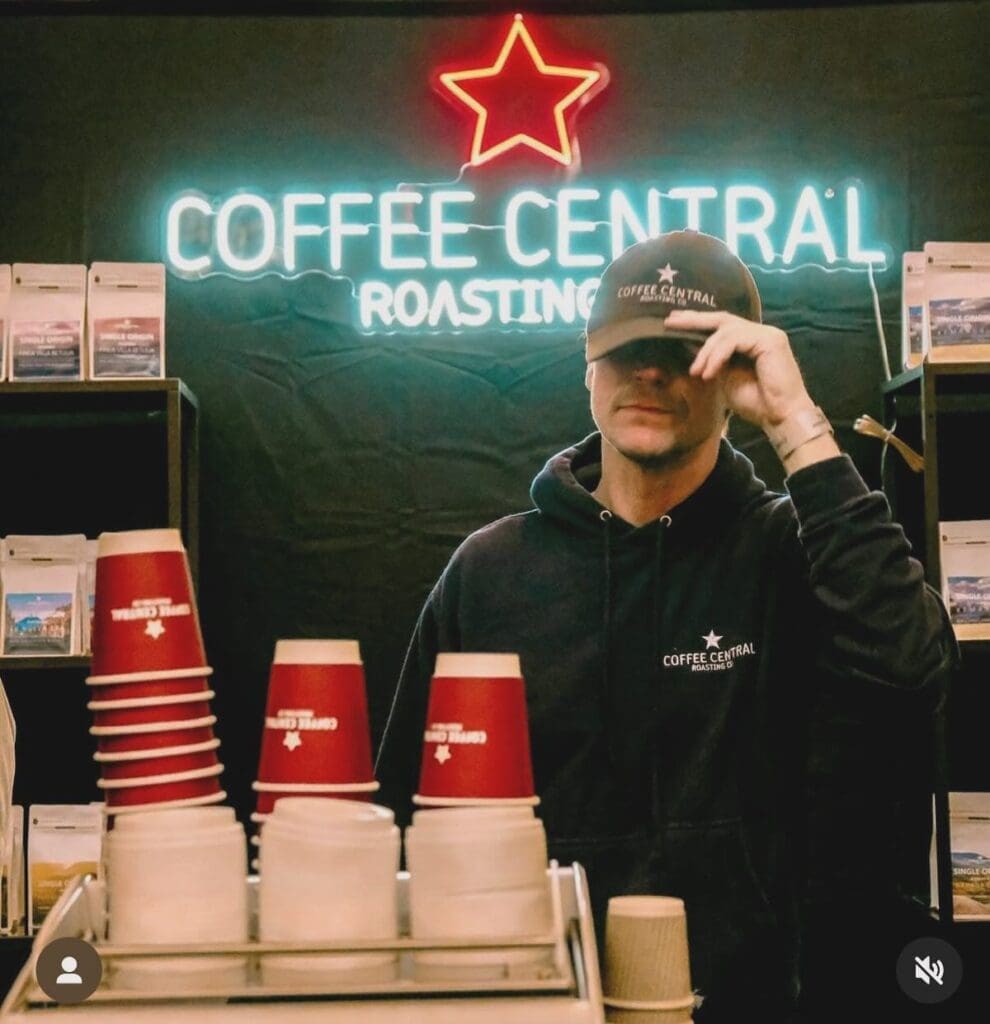
Coffee Central Roasting Co. does something that no amount of visual identity work could achieve on its own. It makes the positioning claim permanent. It is in the name. Every time someone reads it, types it, or says it aloud, the brand is asserting: we are a roasting company. This is what we do first and foremost.
Name extensions of this kind are a precise strategic tool. They work because they carry the equity of the existing name — the recognition, the associations, the trust — while adding a definitional layer that shifts the frame. Coffee Central already meant something to its customers. ‘Roasting Co.’ redirected what it meant, without asking anyone to start from scratch.
This also had practical advantages for the dual B2B and B2C audience. Wholesale hospitality buyers respond to specificity and craft credentials. Direct retail customers respond to authenticity and story. ‘Roasting Co.’ serves both: it signals expertise to the trade buyer and provenance to the consumer.
Evolution, not replacement
The visual identity work followed from the same logic. The recommendation was to evolve the existing mark rather than replace it — a decision that is less instinctive and more strategic than it might appear.
In food and drink, heritage has commercial weight. Customers who have been buying from a business for years have formed a relationship with its visual language. An abrupt rebrand can feel like a breach of that relationship — like waking up to find the business you trusted has been replaced by something unfamiliar. The risk is relational as well as aesthetic.
The identity evolution drew deliberately on the language of coffee itself: the colour and vibrancy of coffee as it grows and ripens, married up to the warm, deep tones of roasted beans, the texture of the sacks in which green coffee arrives, the craft of the roasting process made visible. Typography and mark-making referenced those material touchpoints — this was not decoration applied over a positioning, but visual language derived from it.
The result was an identity that looked like it had always been there, made more intentional. Existing customers recognised it. New audiences read it as established. Both responses were the goal.
Preserving the dual audience
A less obvious but equally important strategic consideration was the need to protect Coffee Central’s dual commercial model. The business operates in both B2B — wholesale supply to hospitality venues, own-label coffee programmes — and B2C, selling directly to consumers through retail and online.
These audiences have different needs, different purchase drivers, and different relationships with brand. The positioning and identity needed to speak credibly to both without feeling like it was straining to do so. The craft-led position achieved this: it gave the hospitality buyer the expertise signal they need, and gave the consumer the authenticity and story they want. Equipment supply continued alongside this, but was no longer the frame through which the whole business was understood.
The Outcome
The rebrand coincided with a period that would test almost every business in hospitality: the pandemic years. In that context, the most meaningful measure of any brand investment is not growth — it is resilience. Coffee Central weathered a period in which many comparable businesses did not.
Brand clarity does not protect a business from external shocks. But it does affect how a business is perceived when conditions are difficult — whether customers see something worth sustaining, whether wholesale accounts hold, whether the business communicates confidence rather than uncertainty. The work done prior to that period gave Coffee Central a clearer, more credible identity to stand behind when it mattered most.

What This Demonstrates
This engagement illustrates something that is often counterintuitive to clients approaching brand work: the most powerful creative decisions are not always the most dramatic ones. Keeping the name. Evolving rather than replacing. Extending rather than abandoning. Finding the story that was already there, and making it visible.
The ‘field to cup’ narrative was not invented for Coffee Central — it was uncovered. The sourcing relationships, the small growers, the passion for provenance: all of it existed before the brand engagement began. The strategic task was to recognise it as the organising idea the brand had been missing, and to build the positioning, the name, and the identity around it.
For businesses in food and drink, ethical supply chains, and the wider sustainable economy, this case study demonstrates something transferable: when craft, ethics, and community feel like separate claims, it usually means the connecting story hasn’t been found yet. Find it, and the brand writes itself.